
Technology
A semantic web for sustainability. Revolutionizing how we write, find, link and reuse data and models.


The software stack
COMPONENTS
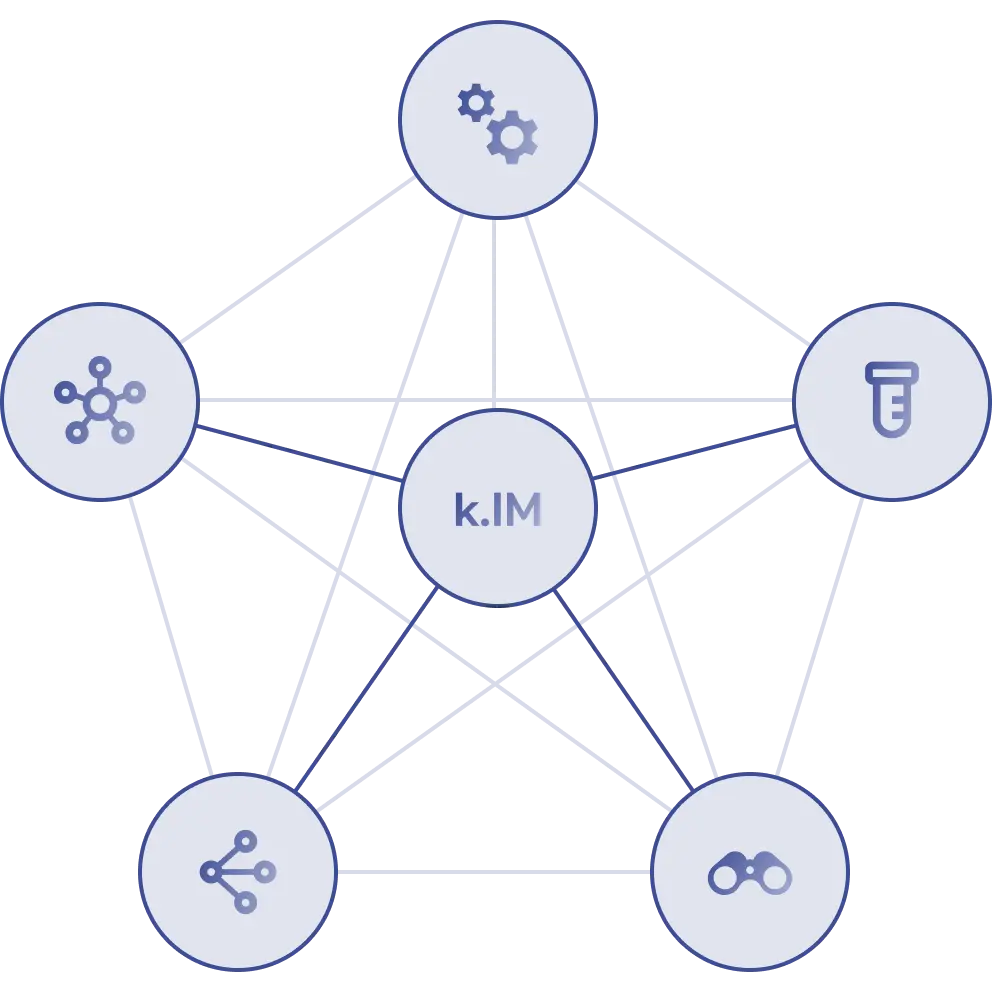
k.LAB provides access to an integrated network of web-accessible models, catalogued and connected through semantics. This user-friendly platform allows you to query the network for information about a concept of interest, merging natural science models (e.g., process-based models) with human behaviour models (e.g., agent-based models). The system automatically resolves differences in units or scale, ensuring that outputs are coherent and useful for decision-making.
k.IM is a controlled natural language designed with English-like syntax to ensure readability and ease of use. It supports integrated scientific modelling by enabling users to collaboratively build, reuse, and extend models in a flexible environment. Utilizing k.IM's semantic annotation and modelling language simplifies and improves the process of tackling complex societal challenges. This approach significantly reduces end-user complexity by providing verifiable and transparent methods.
k.IM
Simplifying the complex
k.Engine is a computational system that responds to user queries by leveraging data and models within a user-defined spatiotemporal context. It integrates data and models from a network into a cohesive computational workflow. This workflow is executed to create a digital twin, which accurately represents the intended answer to the query.
k.Engine
The core computational system
k.Modeler is the integrated development interface that allows contributing users to add new resources to the platform and model scenarios to gain more knowledge. The k.Modeler offers development tools for the k.IM language.
k.Modeler
Integrated Development Environment (IDE)
k.Explorer is the most general-purpose in a family of web-based applications that allow users to easily query a k.Engine to build a model and visualize its results. It also serves as a base for more specialized applications. It facilitates building a query using the k.LAB knowledge base, providing suggestions to match words typed in the entry field.
k.Explorer
Query and Visualization Tool
k.LAB services are a collection of modular and independently deployable components that support the operations orchestrated by the k.Engine. These services facilitate various tasks such as data extraction, pre-processing, reasoning, and workflow processing. Beyond providing software functionalities, k.LAB services manage all knowledge, including semantic projects, thereby aiding the k.Engine in effectively answering user queries. This service-based architecture ensures flexibility and scalability, enabling continuous development and deployment of individual services as needed.
k.LAB Services
Modular and flexible
k.Hub is the central authentication and coordination system that manages user access to k.LAB services, which provide data and models. It oversees user groups and their associated rights, ensuring secure and organized access to information within the system. k.Hub connects the k.Engine to the k.LAB network, facilitating seamless interaction. Its API (Application Programming Interface) allows software components to communicate for tasks such as user registration and authentication, statistics gathering, and user management, all accessible through a web interface.
k.Hub
Central coordination and authentication
Begin your journey with k.LAB: Explore, learn, and collaborate
get started
Start exploring k.LAB today by accessing our hub! Dive into our detailed documentation, explore our source code on GitHub, and become part of our collaborative community.
To create evaluations and explore various scenarios, simply use a modern web browser, such as Chrome or Firefox. With k.Explorer, the primary k.LAB interface, you can query the knowledge base and access linked data and models directly online.
To import, annotate, and publish data and models on the k.LAB semantic web, install the Control Center software package, which includes the local engine (k.LAB engine) with its web-based interface (k.Explorer) and the integrated development environment (k.Modeler).
Explore the technical introduction to our semantic web software - the best source of information to independently learn about k.LAB's features and architecture.
Browse the k.LAB source code on GitHub. Explore, contribute, and join our collaborative community to enhance the k.LAB ecosystem.
Join our k.LAB Moodle course to master the platform. Access detailed modules, practical exercises, and valuable resources to enhance your skills and knowledge.